Floral Autumn Wreath Embroidery
A Designer’s Real-World Review for Small Business Merchandise
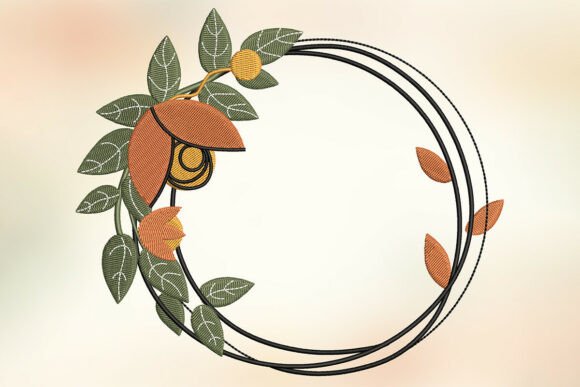
As an embroidery designer who’s developed hundreds of commercial machine embroidery designs for cafés, boutiques, bakeries, florists, and handmade brands, I approach every new file with two questions: Will it translate cleanly across diverse fabrics and applications? and Does it strengthen brand identity—not just decorate? When I first saw the Floral Autumn Wreath Embroidery, its title and description—“elegant, mid-century modern flair” and “beautifully balanced Retro Floral Autumn Wreath Embroidery Design” with a “sophisticated geometric border”—immediately signaled intentionality. This isn’t a generic floral clipart conversion. It’s a considered machine embroidery design built for purpose: to elevate small business merch without sacrificing clarity or wearability.
First Impression: Elegant, Not Overly Ornate
The Floral Autumn Wreath Embroidery reads as warm, refined, and quietly confident—neither fussy nor minimal. The “multi-ring circular” structure suggests rhythm and balance, while “mid-century modern” implies clean lines, intentional negative space, and restrained detail. That’s critical for business use: too much intricacy collapses at small sizes; too little feels forgettable. This design lands in the sweet spot—friendly enough for a neighborhood bakery apron, polished enough for a boutique’s custom tote bag design, and distinctive enough to serve as a signature embroidered patch on staff uniforms.
Where It Shines in Commercial Embroidery Projects
In real-world small business applications, the Floral Autumn Wreath Embroidery delivers versatility:
- Embroidered patches: Its circular symmetry and defined outer ring make it ideal for sew-on or iron-on patches—especially for pet brands, craft studios, or local event merch where durability and visual impact matter.
- Apron embroidery & cap embroidery: Positioned on the chest or front panel, it communicates care and craftsmanship. The geometric framing helps it hold shape even on curved surfaces like baseball caps.
- Tote bag design & product packaging accents: As a subtle corner motif or centered mark, it adds tactile sophistication without overwhelming hand-printed labels or kraft packaging.
- Custom apparel & staff uniforms: On work shirts or jackets, it reads as professional yet personable—ideal for creative studios or wellness-focused brands that want warmth without cliché.
- Etsy branding & handmade product presentation: Paired with a simple monogram or shop name, it becomes part of a cohesive visual language—reinforcing authenticity and attention to detail.
Smart Placement & Practical Limits
Even strong designs have boundaries. For the Floral Autumn Wreath Embroidery, exercise caution in these scenarios:
- Small patch sizes under 2.5 inches: While its structure is clean, fine inner details may blur. Always test at intended size before bulk production.
- Cap fronts with high curvature: The multi-ring layout can distort if digitized without proper underlay or stitch direction planning—confirm your digitizer adjusted for dome tension.
- Textured fabric or dark uniforms: High stitch density in floral elements may mute on heavy twill or absorb contrast on charcoal/black. Test thread colors against actual fabric—not just on screen.
- Frequent-wash items (e.g., café aprons): Ensure stabilizer choice matches fabric weight and laundering frequency. A tear-away alone won’t suffice for dense wreath fills.
How It Builds Brand Identity—Beyond Decoration
For small businesses, every embroidered element is a silent ambassador. The Floral Autumn Wreath Embroidery doesn’t just say “autumn” or “floral”—it says intentional. Its mid-century modern sensibility signals thoughtfulness, timelessness, and design awareness. That builds customer trust: shoppers equate refined execution with product quality and brand reliability. When used consistently—as an embroidered patch on staff totes, a sleeve detail on limited-run tees, and a subtle mark on product tags—it creates visual consistency across touchpoints. And because it’s rooted in seasonal warmth without being literal (no pumpkins or falling leaves), it supports year-round recognition—especially when paired with complementary design assets like typography or color palettes.
Essential Embroidery Designer Notes Before Production
If you’re sourcing this as a digital embroidery file for commercial use, here’s what I recommend—based on years of avoiding rework and client revisions:
- Test it in black and white first—this reveals spacing issues, stitch overlap, and legibility gaps invisible in color previews.
- Check how it scales down to 2 inches—does the inner geometry remain distinct? If not, simplify or request a small-size variant.
- Review thread color contrast against your base fabric—especially for light threads on dark textiles. What looks elegant on screen may vanish in person.
- Inspect spacing between rings and floral motifs—tight gaps risk skipped stitches or fabric puckering on lightweight materials.
- Confirm hoop size compatibility with your embroidery machine and typical garment zones (e.g., left chest = 4" x 4" max).
- Test on real fabric—not just stabilizer swatches—with your intended needle, thread, and machine tension settings.
- Create a printable mockup for client approval before stitching. Visual context prevents misaligned expectations.
- Compare it beside your existing logo and other design assets—does it harmonize or compete?
- Verify commercial licensing explicitly. Even if labeled “for small business use,” confirm redistribution rights if selling finished products (e.g., Etsy patches or branded totes).
The Floral Autumn Wreath Embroidery isn’t just another floral wreath—it’s a strategic tool. When applied with intention, it transforms everyday merchandise into memorable brand moments. Whether you’re launching a new line of handmade goods, refreshing staff uniforms, or designing limited-edition event merch, this embroidery file offers elegance with utility, seasonality with staying power, and artistry with adaptability. Just remember: great embroidery starts with smart testing—not just beautiful files.